Learning Blockchain without Coding

Bitcoin and Blockchain
What exactly is Bitcoin, and why is it so groundbreaking? Think of Bitcoin as digital gold - a scarce asset that can be traded and stored securely online. Unlike traditional currencies, which are controlled by central authorities, Bitcoin operates on a peer-to-peer network, free from censorship or interference.
The secret sauce behind Bitcoin's success is its underlying technology: Blockchain. This distributed ledger system records all transactions on a public database, ensuring transparency and security. Each block in the chain contains a cryptographic hash of the previous block, creating an immutable record of transactions.
What sets Bitcoin apart is its fixed supply. Just like gold, there's a finite amount of Bitcoin that can ever exist - 21 million to be exact. This scarcity is what makes Bitcoin a coveted digital store of value, immune to inflation or manipulation by governments.
But Bitcoin is more than just a digital currency; it's a symbol of freedom and financial sovereignty. With Bitcoin, anyone can participate in the global economy without relying on intermediaries or third parties. It's a testament to the power of decentralization and the potential for a truly borderless financial system.
Ethereum and Smart Contracts
In the world of blockchain technology, Ethereum stands out as a pioneer, offering more than just digital currency transactions. Founded by Vitalik Buterin and a team of visionaries, Ethereum expands on Bitcoin's capabilities by introducing smart contracts.
Smart contracts, a concept initially proposed by Nick Szabo in 1994, found their true home on the Ethereum platform. These contracts enable decentralized transactions, organizations, and agreements, all without the need for a central authority.
Web3
Web3 represents a new era of the internet powered by blockchain and smart contracts, offering a decentralized and permissionless environment for transactions and agreements. Unlike previous versions of the web, Web3 relies on decentralized networks rather than centralized servers, ensuring censorship-resistant and transparent interactions.
Web1: The permissionless open sources web with static content.
Web2: The permissioned web, with dynamic content where companies run your agreements on their servers.
Web3: The permissionless web with dynamic content.
Chainlink
Chainlink is like the messenger between the real world and blockchain smart contracts. Smart contracts are self-executing contracts with predefined conditions, but they can't directly access external data like weather information or stock prices. That's where Chainlink comes in.
Imagine you have a smart contract for a weather-based insurance policy. The contract pays out if it rains more than 5 inches in a day. Chainlink acts as the bridge by fetching real-time weather data from a trusted source, like a weather API, and feeding it into the smart contract. If the data confirms that it rained more than 5 inches, the contract automatically triggers the payout to the insured party.
It's like giving smart contracts eyes and ears to understand and respond to events in the world outside the blockchain
The problem with traditional agreements
In the realm of traditional agreements, trust is often a fragile commodity, susceptible to manipulation and deception. Take, for instance, the infamous case of McDonald's Monopoly game in the 80s and 90s, where insiders rigged the system, betraying the trust of customers and failing to deliver on promises.
Enter smart contracts, the game-changer in modern agreements. A smart contract is like a digital agreement deployed on a decentralized blockchain, where its terms are immutable, transparent, and automatically executed.
Imagine if McDonald's Monopoly game operated on a blockchain through a smart contract. Every aspect of the game, from distributing game cards to awarding prizes, would be governed by transparent and tamper-proof code. Fraudulent activities like rigging the game would be impossible due to the inherent properties of smart contracts.
In essence, smart contracts eliminate the need for blind trust by providing a secure and transparent framework for agreements. They ensure that parties uphold their promises and that agreements are executed exactly as programmed, without the risk of manipulation or deceit.
Some cool things about Smart Contracts
No Boss, Just Friends: Smart contracts live in a place called a blockchain, where lots of people help keep them safe and fair. It's like having a bunch of friends watching over your special notebook to make sure everything goes smoothly.
See-Through Rules: Everyone can peek into your special notebook and see the rules you've written. This makes sure nobody's trying to pull a sneaky trick. But don't worry, personal stuff is still kept secret, just like hiding your diary under your bed.
Super Quick and Easy: Smart contracts are like speedsters! They can finish tasks really fast, way quicker than waiting for something to happen in real life. It's like getting your homework done in a blink.
Locked and Secure: Once you write down the rules in your special notebook, they can't be changed. It's like locking your bike to a sturdy pole – nobody can mess with it! This keeps everything safe and secure.
Fair Play Always: With smart contracts, everyone has to play fair. The rules are set, and nobody can change them halfway through the game. It's like having a referee at a soccer match making sure everyone follows the rules.
Nodes and Gas in Blockchain Transactions
Nodes: Think of nodes as the superheroes of the blockchain world. They're the ones responsible for keeping the blockchain running smoothly. Depending on the blockchain network, they might be called miners or validators. These nodes process transactions, validate blocks, and maintain the integrity of the network. As a reward for their efforts, they earn a fraction of the native cryptocurrency of the blockchain they're operating on. For example, Ethereum miners receive Ether, while those on Polygon get rewarded in MATIC tokens.
Understanding Gas: Now, let's talk about gas. In the context of blockchain transactions, gas is like fuel for your car. The more complex the transaction, the more gas it needs to run smoothly. For example, simple tasks like sending cryptocurrency require less gas, while more complicated actions like minting an NFT or deploying a smart contract demand more gas due to their complexity.
Calculating Transaction Fees: To understand how much it costs to perform a transaction on the blockchain, we need to calculate the transaction fee. This fee is determined by multiplying the amount of gas used by the gas price in Ether (not Gwei, which is a smaller unit of Ether). So, Transaction fee = gasPrice * gasUsed.
Let's break it down further with an example:
Suppose you're sending Ether from your wallet to a friend's wallet on the Ethereum network. You set a gas limit of 21,000 units and a gas price of 10 Gwei (0.00000001 ETH per gas unit).
During the execution of your transaction, it turns out that only 20,000 units of gas are actually consumed due to the simplicity of the transaction.
Now, to calculate the transaction fee:
Gas Used = 20,000 units Gas Price = 10 Gwei (0.00000001 ETH per gas unit)
Transaction fee = Gas Price \ Gas Used*
***Transaction fee =***0.00000001 ETH/gas 20,000 gas
Transaction fee = 0.0002 ETH
So, the total transaction fee for this example would be 0.0002 ETH.
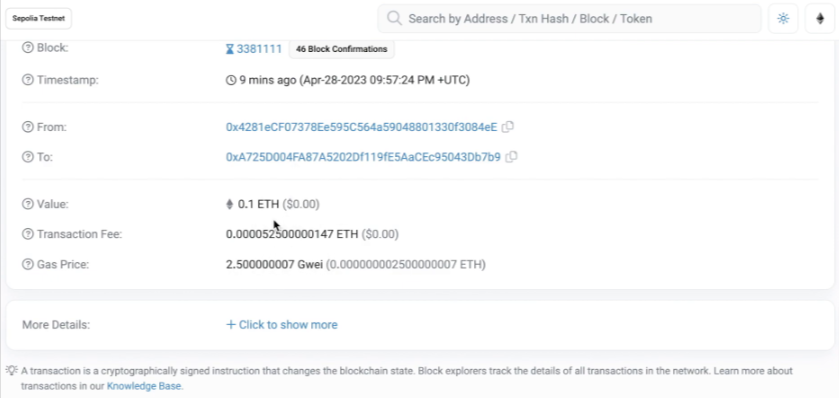
It's important to note that gas prices can fluctuate based on network demand and congestion. Miners prioritize transactions with higher gas prices, so users may choose to adjust their gas prices accordingly to ensure timely processing of their transactions.
Conclusion
Understanding blockchain concepts fully takes time and effort, and reading this blog is just a start. Stay tuned for upcoming blogs where we'll explore more. Remember, learning about blockchain is a journey. Happy Learning, and see you next time!
Comments
Join the discussionNo comments yet. Be the first to comment.